
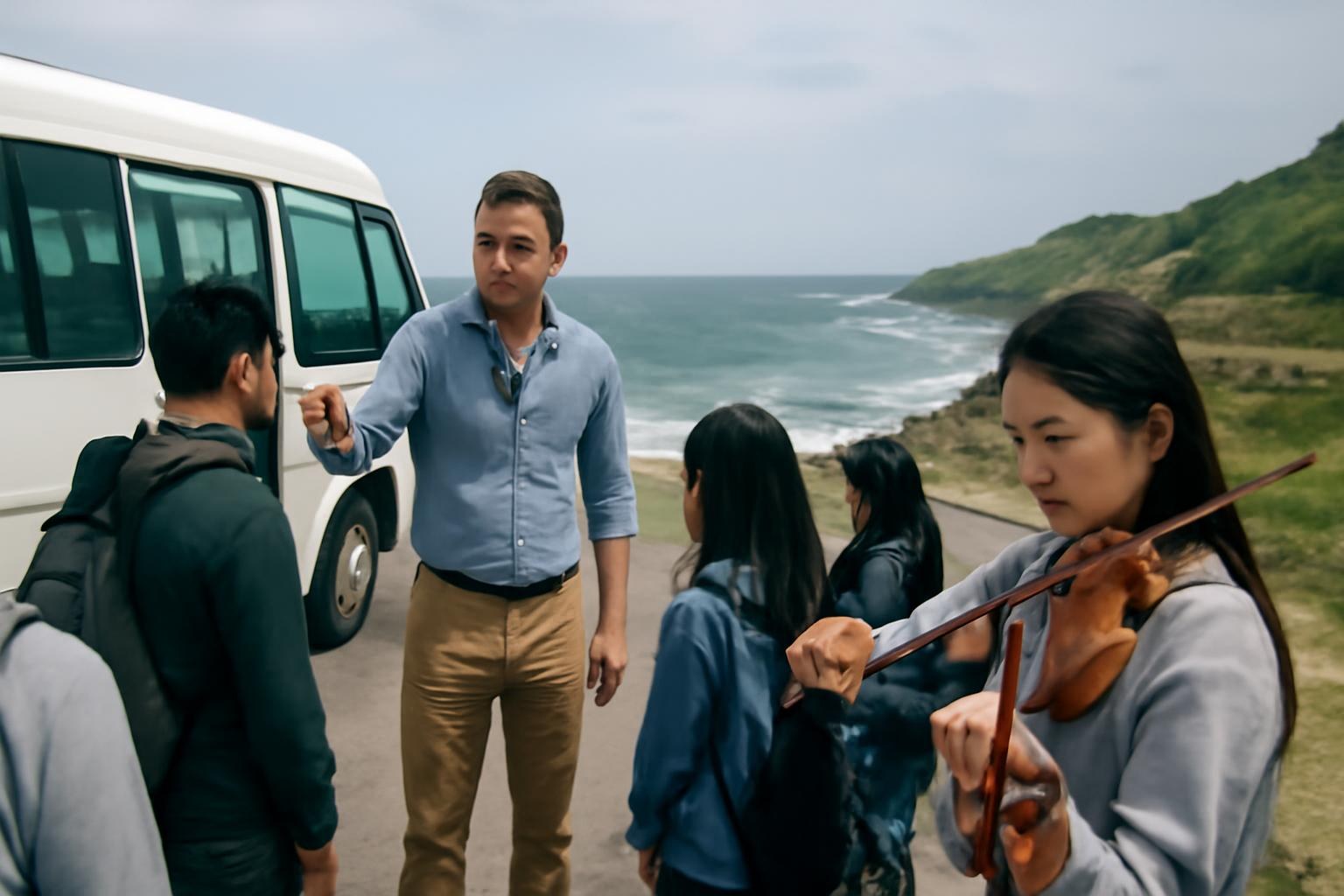
Last Friday, our class boarded a minibus and headed eastwards to the northeastern coast for our annual field trip. The morning sky was foggy, and a thin layer of smog still hung over Taipei as we drove away. Our science teacher, a warm and humorous westerner named Mr. Collins, greeted everyone with a wide smile. Almost immediately, he began to break the ice by sharing a funny story about his very first week living in Taiwan, and the whole bus burst into laughter.
Mr. Collins carried an old walkman in his bag and said he still preferred it to modern music players. One student pointed out that cordless earphones were far more practical these days, which made everyone laugh again. He had also brought a thermos full of herbal tea that his wife had brewed in a teapot that morning. "It keeps my throat warm on cool days," he explained with a smile. On the contrary, most students had brought cold sodas and packaged snacks from convenience stores. One girl sighed that her store-bought sandwich was completely tasteless and tossed it aside after the first bite.
When we arrived at the beach, the fog had lifted and the scenery was breathtaking. A flock of seagulls glided gracefully above the waves, while a tiny sparrow hopped along the sand near our feet, searching for crumbs. Mr. Collins knelt down and pointed to a locust resting quietly on a grass blade. He explained that massive locust swarms could sweep across farmland and destroy entire crops before they even had a chance to ripen, making them one of the most feared insects in agricultural regions around the world.
After our walk, Mr. Collins set up a cordless microphone near the shore and gave a short environmental talk. He explained how prolonged exposure to smog could gradually damage a person's eyesight and lead to serious respiratory problems. He even mentioned that researchers stationed in Antarctica had recorded some of the cleanest air on Earth, completely untouched by industrial pollution. "If you think algebra is hard," he joked, "imagine spending a winter there running outdoor experiments!" One student groaned, "Ouch — that sounds absolutely freezing!" He also noted that strict airspace regulations over coastal nature reserves help reduce noise that disturbs local wildlife.
During the lunch break, a talented violinist from our school music club performed right on the beach. It was the most memorable live music we had ever experienced in such a wide, open setting. Everyone sat quietly on the sand and listened. Mr. Collins later said that just as correct punctuation gives writing its rhythm and clarity, music gives emotion its truest shape. Both, he added, are skills that reward years of patient, devoted practice.
As we packed up to leave, Mr. Collins admitted he had a sweet tooth and asked if anyone could point him to a good local dessert. A student recommended a nearby stall famous for fresh mango sorbet, as the mangoes in the area had just fully ripened and were at their sweetest. On the drive home, our minibus passed beneath a busy airspace zone, and everyone craned their necks to watch a large cargo plane rumble overhead. "I want to visit Antarctica someday!" someone shouted from the back seats, and the whole bus cheered.
By the time we returned to school, everyone agreed the trip had given us far more than a day away from class. We had observed real ecosystems, discussed global environmental challenges, and been moved by live music under an open sky. On the contrary to our usual classroom routine, that day reminded us that some of the most powerful lessons happen when you step outside and engage with the world around you.